Finding an Apartment
Searching for an affordable apartment in Tokyo can be challenging, particularly for those who are new to Japan.
Housing Search Options
Science Tokyo students and researchers typically have the following options when searching for an apartment:
- Visit a real estate agency in the area where you wish to live.
- Search apartment listings on the Internet.
- Search apartment listings at Science Tokyo Co-op* and contact the agency or landlord in charge.
When visiting Co-op, bring someone who speaks Japanese with you if you do not speak Japanese well.
* The relevant Co-ops are located at the following three locations: the first floor of Extracurricular Building 1 on Ookayama Campus, the first floor of the H2 Building (Suzukake Hall) on Yokohama Campus, and the B1 floor of Building 5 on Yushima Campus.
Real estate agencies with English-speaking staff.
Real estate agency websites and listings in English
Working with a Real Estate Agency
When visiting a real estate agency, bring someone who speaks Japanese with you if you do not speak Japanese well. Also, dress neatly to make a good impression on the real estate agent and/or property owner.
Your Housing Requirements
Clearly state your housing requirements, such as rent, closest train station, size, and furnishings. We suggest filling out the following House-Hunting Requirements Checklist and showing it to the real estate agent.
Apartment Advertisements
At real estate offices and websites, you can find apartment advertisements similar to the one below. Hovering your mouse over linked terms will show you their English translations. Clicking the links will take you to relevant descriptions.
Sample Advertisement
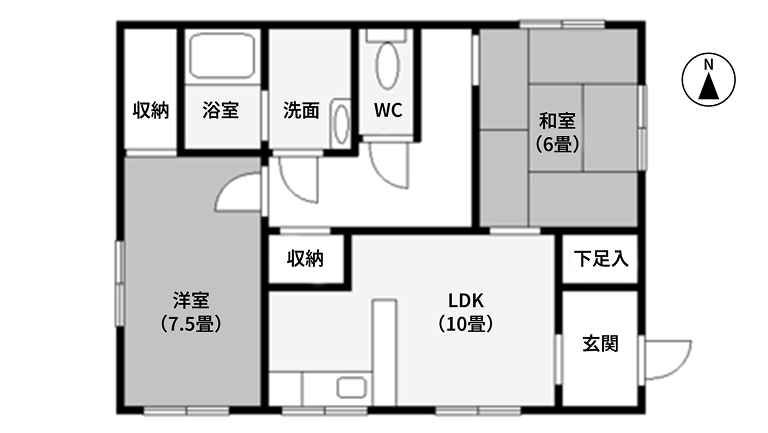
| 物件種目 | 貸アパート |
|---|---|
| 最寄駅 | 大岡山駅 |
| 間取りタイプ | 2LDK |
| 賃貸条件 | 家賃:130,000円 一時金等:礼金1ヶ月・敷金2ヶ月 |
| 交通 | 目黒線『大岡山』駅 徒歩5分 |
| 建物 | 構造・規模:木造2階建 2階部分 使用部分面積:45m2 (13.6坪) |
Apartment Layouts
In Japan, apartment layouts are expressed using terms such as 1R, 1DK, 2LDK, etc. The number denotes the number of bedrooms. The letters denote other rooms, as follows:
- L: Living room
- D: Dining room
- K: Kitchen
- DK: One area serving as a dining room and kitchen
- LDK: One area serving as a living room, dining room, and kitchen
A 2LDK, for example, is an apartment with two bedrooms and a living-dining-kitchen area.
Size Measurements
Room size is often measured in jo (畳 or 帖). Jo refers to the size of one tatami mat and is approximately 180 x 90 cm. Total size may be measured in tsubo, where one tsubo is approximately 3.3 m2. Aside from these measurements, square meters (m2) may also be used.
Flooring and Furnishings
Various terms are also used to refer to the type of flooring and furnishings:
- 和室 (Washitsu): Japanese-style room with tatami flooring
- 洋室 (Yoshitsu): Room with western-style flooring, i.e., vinyl, carpet, wood, etc.
- 玄関 (Genkan): Entrance
- 下足入 (Gesoku-ire): Shoe storage
- 洗面 (Senmen): Washroom with sink
- 収納 (Shunou): Storage space
Location
Location is usually described in walking distance from the nearest station or other landmark.
- 徒歩XX分 (Toho XX fun): XX-minute walk
In general, a one-minute walk corresponds to about 80 meters.
Viewing the Apartment
If you find an apartment that matches your requirements, have the real estate agency show it to you. Do not sign a contract without actually visiting the site. Carefully check the apartment, as well as the surrounding area, including the nearest train stations, bus stops, supermarkets, convenience stores, and any other things important to your daily life.
Tip
What is the difference between apaato (アパート) and mansion (マンション)?
Apaato are low-rise buildings of wooden or light steel-frame construction, while mansion are constructed with reinforced concrete, steel, or steel-reinforced concrete. As a result, mansion have thicker, more soundproof walls and are typically more stable during earthquakes.
Beware of extreme deals
If you find an apartment that is priced significantly below average, there is likely a reason. The property may be old, located in an inconvenient area, be equipped with an older squat-type toilet, or have some other shortcoming. Be sure to ask the real estate agency about the reason beforehand.
No shoes!!
Do not wear shoes in the apartment. Remove your shoes at the entrance (genkan) before walking further in.